Working build · sample
From weekly reporting to weekly decisions.
A reliable weekly view that checks the information, calculates agreed measures and turns verified changes into questions and follow-ups—with a person in control.
Business situation
Several exports. One leadership decision.
This beauty-brand example uses sample data across online sales, wholesale, paid media, email, affiliates and product launches. Its weekly information lives in separate exports.
Preparing an update requires manual reconciliation and still leaves uncertainty about which changes are reliable, why they happened and who should follow up.
What I built
A governed path from raw information to a reviewed brief.
Completeness and quality
Agreed business rules
Numbers cannot change
Questions and options
Edit and approve
Inside the demonstration
Business context, visible checks and decision-ready output.
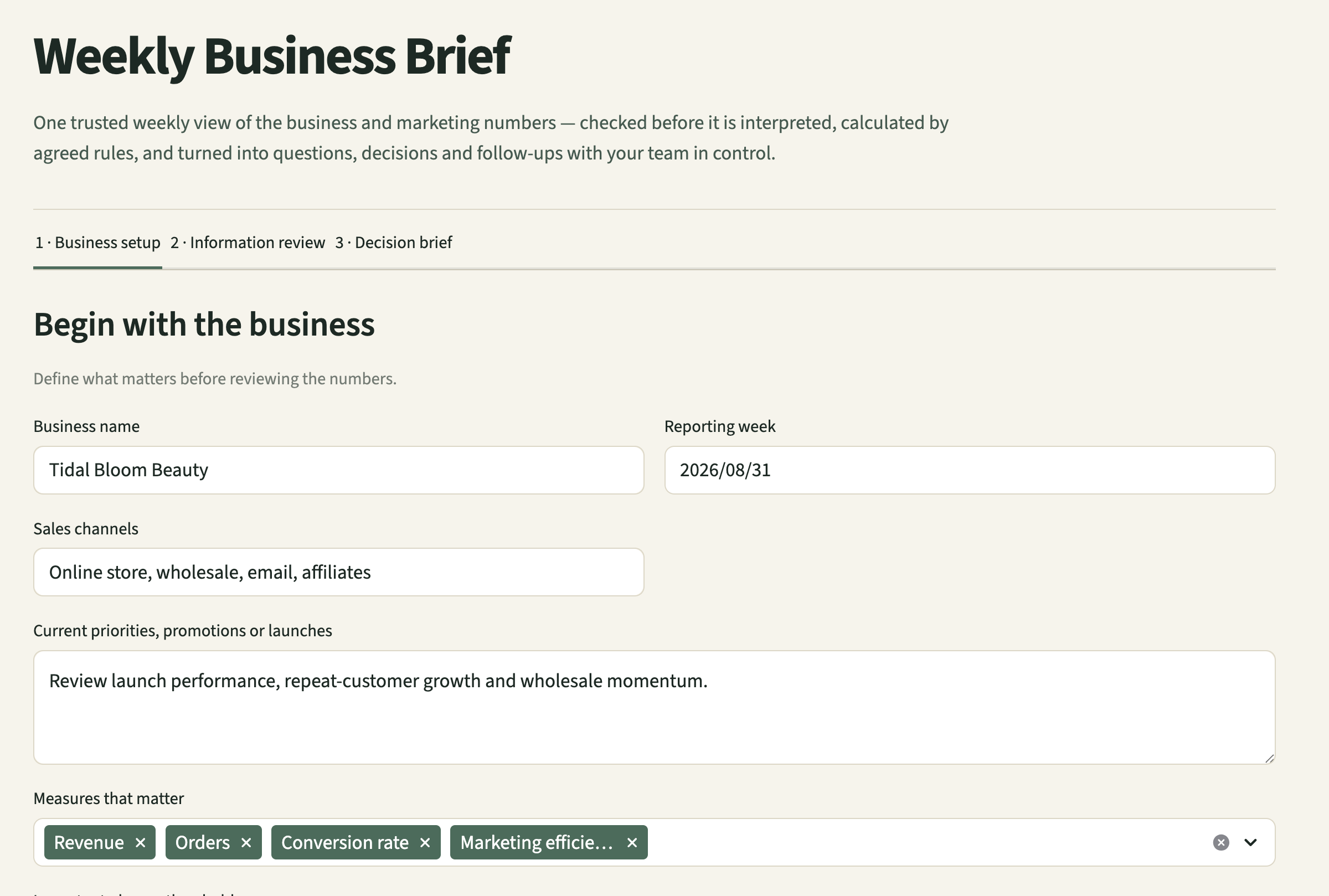
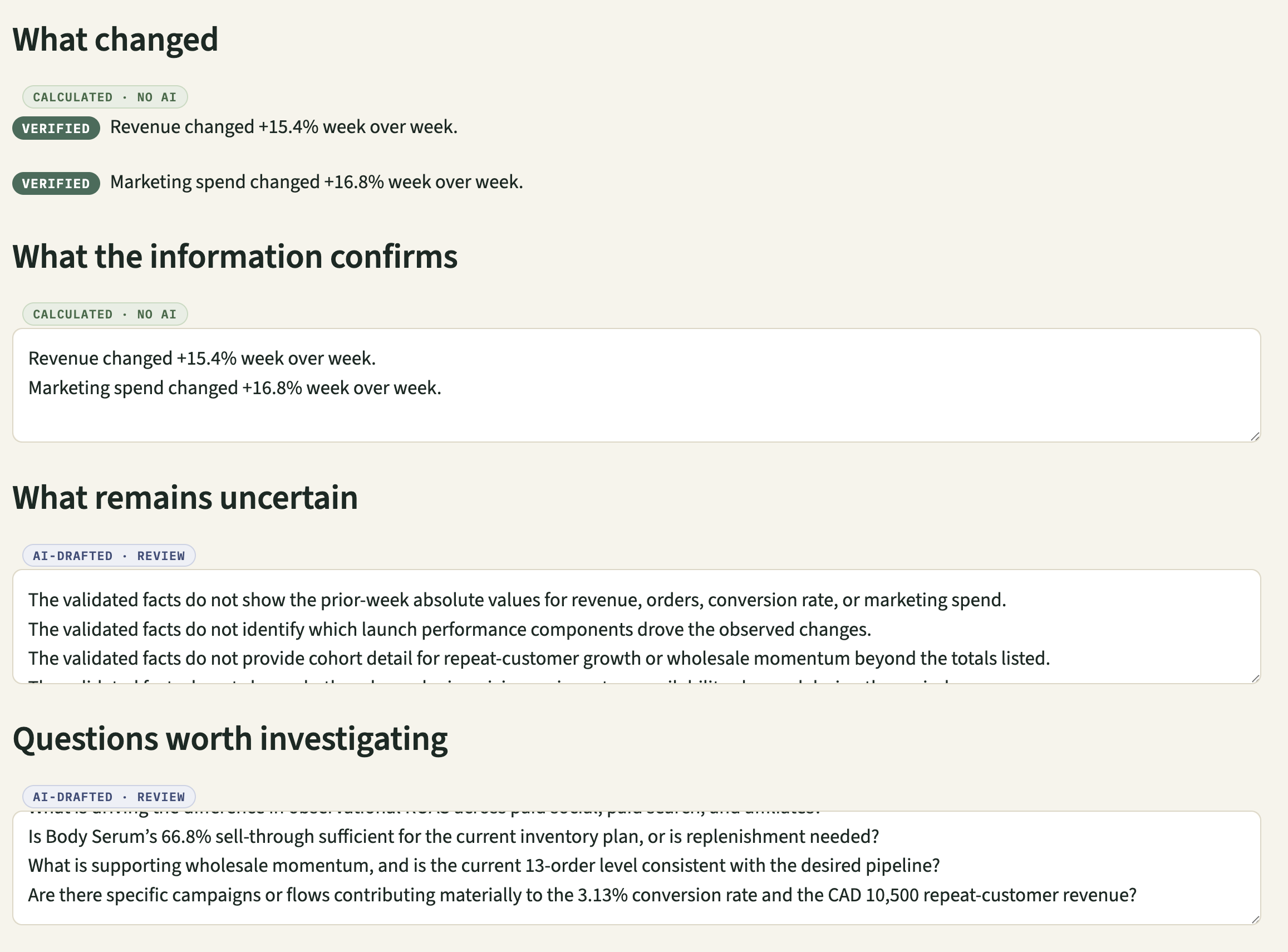
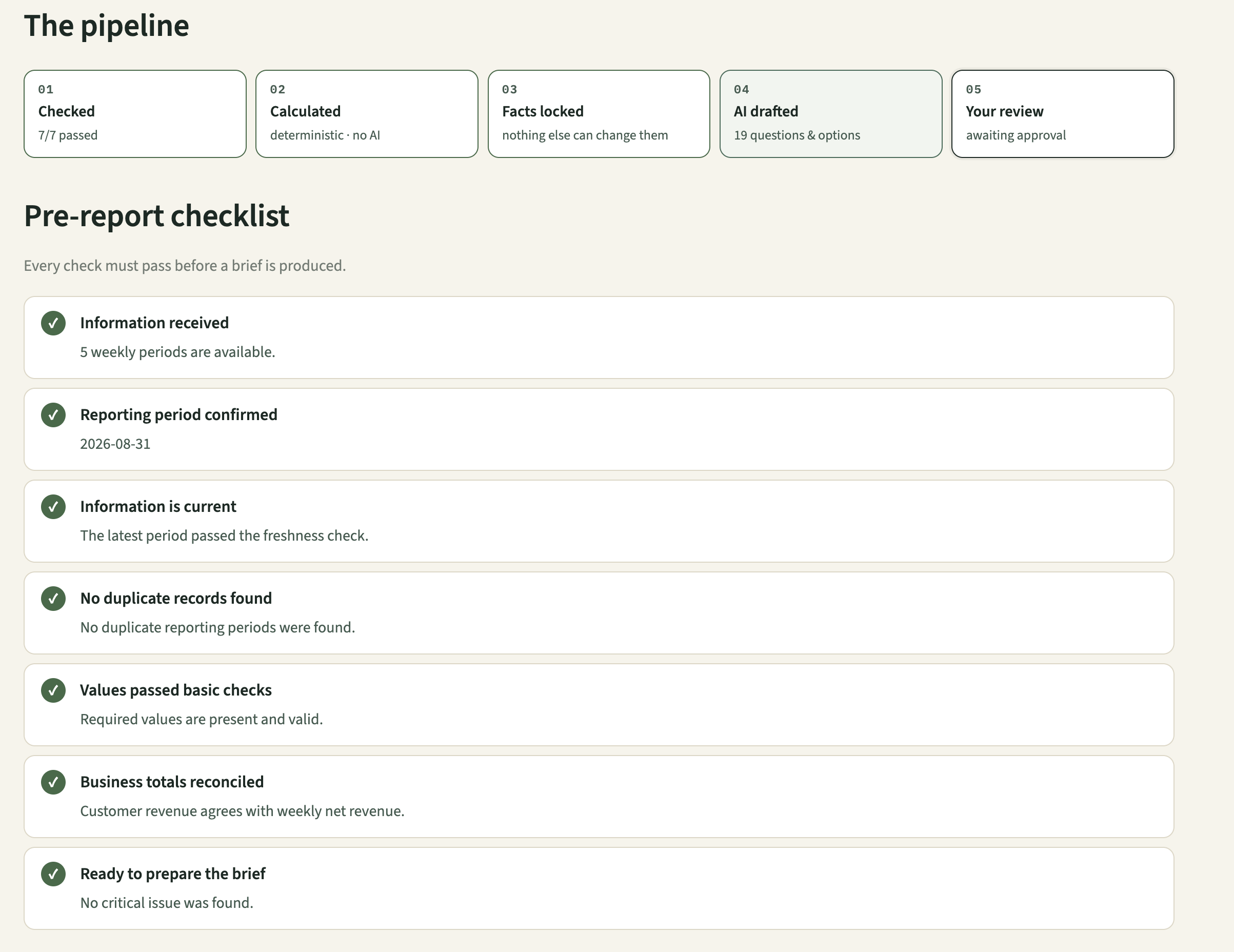
Customer cohort sample · fictional data
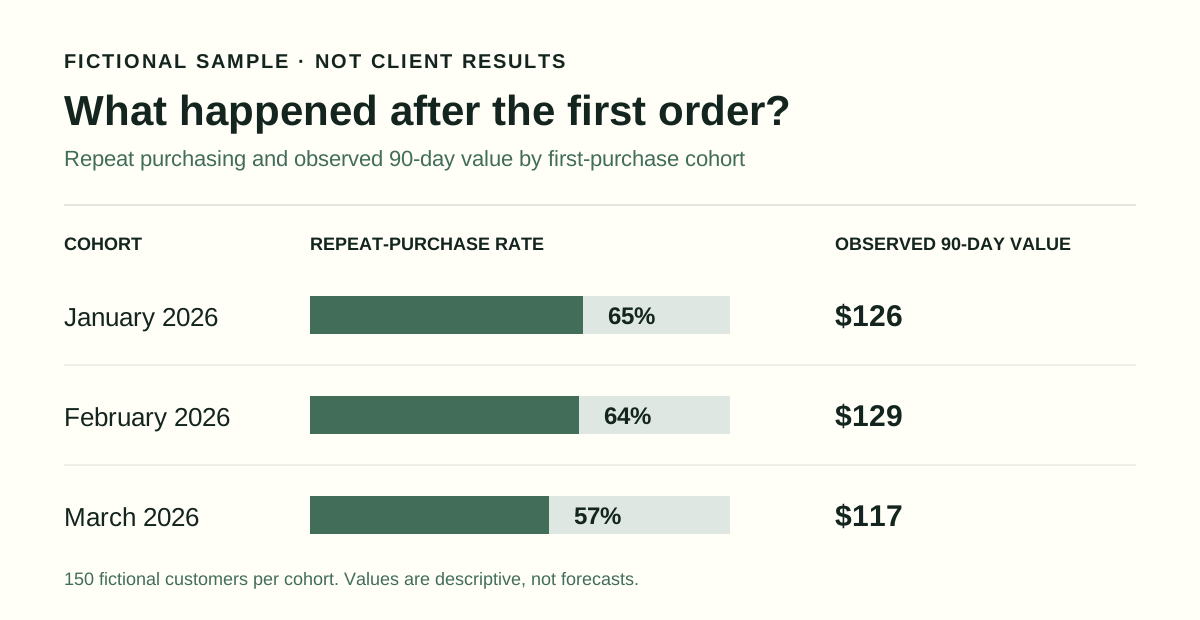
What happened after the first order?
This customer-level sample follows 450 fictional buyers—150 in each first-purchase cohort—through a consistent 90-day observation window. The identifiers, orders and results are synthetic and demonstrate the method only.
| First-purchase cohort | Customers | Repeat-purchase rate | Average time to second purchase | Observed 90-day value per customer |
|---|---|---|---|---|
| January 2026 | 150 | 65% | 41 days | $126 |
| February 2026 | 150 | 64% | 41 days | $129 |
| March 2026 | 150 | 57% | 43 days | $117 |
Acquisition-channel comparison
| Acquisition channel | Customers | Repeat-purchase rate | Observed 90-day value per customer |
|---|---|---|---|
| Organic | 66 | 68% | $132 |
| Paid social | 151 | 64% | $121 |
| 97 | 61% | $124 | |
| Paid search | 136 | 57% | $123 |
First-product comparison
| First product or launch | Customers | Repeat-purchase rate | Observed 90-day value per customer |
|---|---|---|---|
| Hand Care Set | 132 | 67% | $118 |
| Body Wash Launch | 168 | 60% | $119 |
| Body Serum Launch | 150 | 59% | $134 |
No projected LTV is shown. There is not yet enough history for a useful lifetime-value projection. Observed customer value is shown instead, and differences in this fictional sample are descriptive rather than causal.
Questions this view supports
- Which acquisition sources are associated with returning customers?
- Did customers from a launch purchase again?
- Which first products are associated with stronger repeat behaviour?
- Is there enough history for a customer lifetime value estimate to be useful?
Human and AI responsibilities
AI explains. It does not rewrite the facts.
Business measures use reproducible rules. AI may organize uncertainties, questions and decision options. A person edits and approves the final brief; nothing is distributed automatically.
Demonstrated result
The target is preparation and review in under ten minutes. A two-hour manual baseline is illustrative, not a measured client result. End-to-end time savings and adoption still need to be measured with a real workflow owner. Automated tests verify specific calculations and failure cases; passing those tests does not establish business impact or universal AI accuracy.
Evaluation scorecard
What the build is tested to do.
| Area | Target | Evidence |
|---|---|---|
| Deterministic metric accuracy | 100% | Automated calculation tests |
| Critical data failures caught | 100% | Missing, duplicate, stale, invalid and reconciliation tests |
| Unsupported AI facts | 0 | AI cannot replace deterministic factual fields |
| Facts separated from hypotheses | 100% | Governed narrative structure and tests |
| Fact-only fallback | 100% | Brief generation without an API call |
| Preparation time | Under 10 minutes | Measured in each run |
This scorecard describes demonstrated software behavior. Client adoption and business impact require measurement during a paid implementation.
Client starting point
Configure it around the business—not the demo.
A paid review identifies the real decisions, information sources, definitions, owners and baseline effort before the reusable workflow is configured.